The age of AI verification: Beyond the current AI narrative
As AI systems become more capable and more deeply embedded in decision-making, the next challenge is no longer generation alone, but verification, trust and real-world understanding
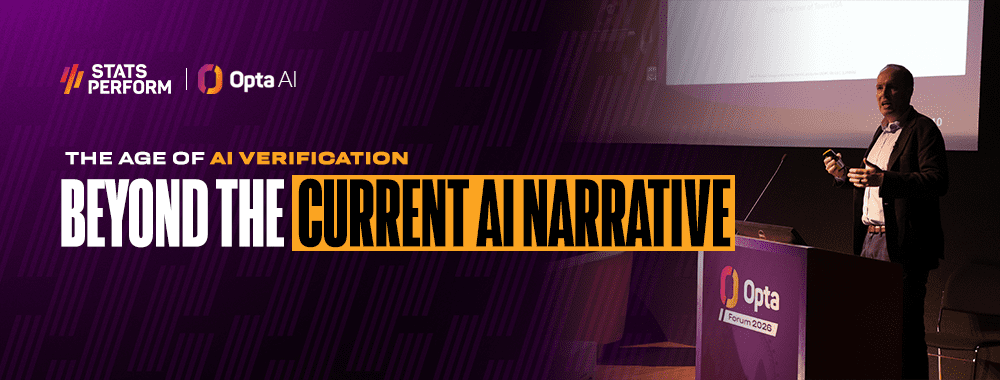
Dr. Patrick Lucey is Chief Scientist at Stats Perform, where he leads the company’s AI research and innovation strategy. In this latest piece, he explores how the conversation around AI is shifting from what systems can generate to what organisations can reliably trust, verify and operationalise at scale – and why sport is becoming a proving ground for that next era.
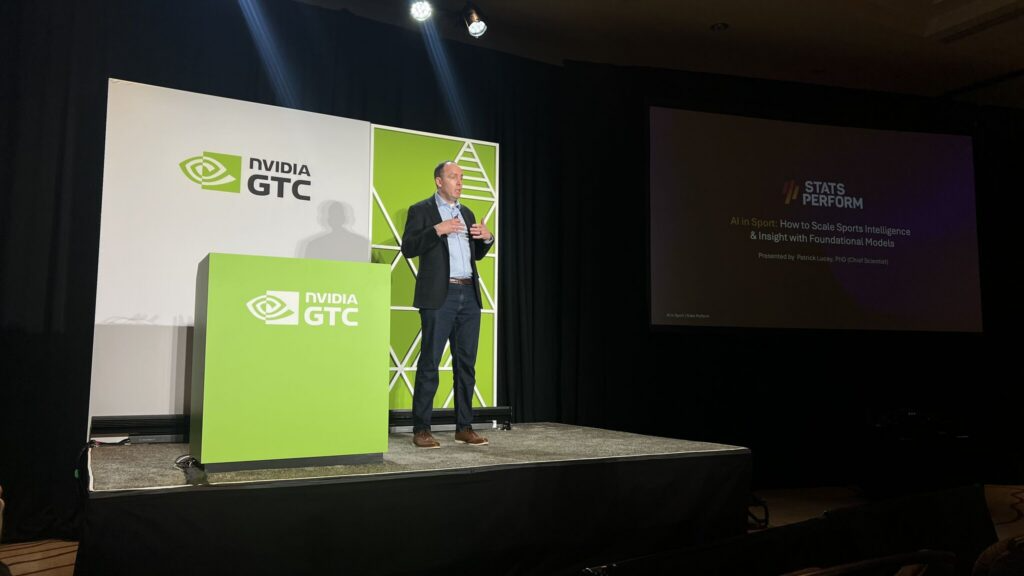
Over the last couple of months, I’ve been across the AI ecosystem – from the high-octane stages of NVIDIA GTC and the MIT Sports Summit to the strategic focus of the Wisconsin AI for Business Summit, our very own Opta Forum, and an EMBA classroom.
Stepping back from the summits and conferences, it’s clear we’ve reached a tipping point. The conversation has shifted from the “novelty” of what current agentic AI models could do to the necessity of what they should do. We are moving away from treating AI as a reactive chatbot and toward treating it as a proactive production system – an “AI Factory”. However, before rolling out these factories, we must ensure the necessary verification and oversight are in place. While the business world focuses on deploying these systems in the digital realm, the research and innovation “buzz” is firmly centered on Physical AI.
But how does this connect to what we are doing in the world of sport?
Sport is unique because it sits at the perfect intersection of the physical and digital worlds. While many industries live entirely within the digital world of text, code and images, sport is fundamentally about what humans do with their bodies in real-time. It is one of the most valuable assets on the planet – not only economically, but socially – and forms part of our global social fabric, connecting communities across borders through a universal language. Because we care so deeply about these human moments, the creation of the data and the utilization of this data via AI must be beyond reproach. My motivation for this article is twofold:
- Bridging the Ecosystems: To ensure the sporting world is fully aware of the rapid shifts in the broader AI landscape – specifically the move toward agentic workflows and “AI Factories” – and how these global trends are now connecting directly to the field of play.
- Sport as the Ultimate Proving Ground: To show those in the non-sporting world that the work we are doing in sports AI is among the most sophisticated in existence. Because we must solve for physical truth in real-time and at scale, sport is the ultimate “stress test” for AI reliability and the next wave of AI, which is centered around verifiability, trust, and reliability.
Below is a summary of the key trends I have picked up on over this time, and how these are connected to what we are doing at Stats Perform.
1. Utilizing tokens wisely
At NVIDIA’s GTC, CEO Jensen Huang emphasized that we have moved beyond the era of the traditional Data Center. For decades, these were passive cost centers – digital warehouses designed for the storage and retrieval of information. Today, we are building AI Factories: facilities where actual work is done. In this new paradigm, Agentic AI is the engine that executes that work.
In practical terms, these Agentic systems are acting like digital employees – systems that can plan, use software, and complete multi-step workflows autonomously. Tools like Claude Code or OpenClaw give a glimpse of this new “automated labor.”
From a business operations standpoint, the discussion has shifted from “How do we use AI?” to “How do we best use AI?” through the lens of value and efficiency. While AI has made writing code or generating content incredibly easy, it also introduces a new burden: the need to maintain and verify new codebases and outputs.
We must be pragmatic about where we utilize these factories. Tokens are not free. Using a high-reasoning agent for a simple spreadsheet query is like using a jet engine to drive to the grocery store. This is why we are seeing AI companies rapidly changing their pricing models to reflect the true cost of utilizing Agentic AI systems. If companies are not careful, they can blow through their compute budget extremely quickly. Additionally, every automated action is also a new security risk – something Anthropic’s Mythos model recently demonstrated by exposing vulnerabilities in seconds that had survived decades of human review.
In many ways, this mirrors a core principle of classical machine learning: sometimes a linear model is superior to a deep neural network because it is easier to regularize, easier to interpret, and harder to break.
The message for 2026 is clear:
If you do not understand how the AI system works and cannot verify it, you probably shouldn’t be creating it. The “Black Box” defense is dead. As regulations like the EU AI Act hit full enforcement and U.S. state laws introduce strict civil liability, organizations are now legally and ethically responsible for every “autonomous” hallucination. You cannot stand behind a system you do not understand.
To succeed in the AI era, organizations need experts who can oversee AI systems, identify edge cases, and intervene when necessary.
2. The era of the context expert
Across the summits and classrooms I visited, one question loomed over every conversation: “What is the future of my job?” For recent graduates and displaced workers alike, the rise of Agentic AI – systems that can autonomously navigate the digital world and write their own software – has created a palpable fear.
We are seeing a paradox in real-time: Computer Science enrollments fell 8.1% this school year, the steepest decline of any major, even as AI becomes the bedrock of future work.
Why the dip? In my view, it’s because the “Era of the Coder” is being replaced by the “Era of the Context Expert.” General coding knowledge is becoming commoditized. The differentiator is deep domain expertise – particularly in the “last mile,” where edge cases, constraints, and real-world variability must be understood and verified. As AI handles the average case, human expertise becomes critical in ensuring systems behave correctly in the scenarios that matter most.
In regulated fields like medicine, law, and finance, the value is shifting from the generative “guess” to the deterministic audit. This is Jevons Paradox in action: as AI makes basic cognitive tasks cheaper and faster, we don’t do less – we produce exponentially more. We’ve seen this before in accounting with the introduction of the electronic spreadsheet – many expected it to reduce the need for accountants, but it ultimately expanded the field. As output scales, so does risk. The result is not less work, but a growing demand for high-level expertise to verify, validate, and ultimately stand behind that work. AI will assist in this process, but accountability cannot be automated – human experts remain essential for verification and sign-off.
However, I don’t see coding going away as a core skill. Instead, the edge will come from combining strong coding ability with deep domain expertise. Increasingly, coding and AI will become foundational across disciplines – not standalone specialties, but core capabilities.
In sports, you cannot fake expertise.
The stakes are too high, and the context is too specific. The new barrier to entry isn’t just technical proficiency – it’s the domain knowledge required to verify AI outputs and operate higher up the value chain, moving from descriptive analytics to prescriptive innovation that creates real impact for teams and fans.
A clear example of this shift emerged at our Opta Forum.
Historically, analysts and data scientists were constrained by the maintenance of dashboards and routine reporting. With Agentic AI, that dynamic is changing. The dashboard is evolving into a verification layer – no longer a destination for discovering insights, but an interface for auditing and validating the work prepared by AI systems. In conversations with leading clubs around the world, a consistent theme emerged: analysts and data scientists are finally able to focus on the problems they’ve always wanted to solve.
This shift enables analysts to move from maintaining outputs to owning their integrity, creating the bandwidth to tackle the backlog of high-value, high-impact problems that were previously out of reach.
3. Physical AI and the rising cost of being wrong
When most people think of Physical AI, they imagine humanoid robots. While robotics is rapidly emerging as the next major frontier, a key enabling breakthrough is the development of world models – AI systems capable of understanding and simulating the physics and interactions of the real world with increasing accuracy. Unlike traditional LLMs and VLMs, which primarily reason over text and images, world models learn joint representations of objects, environments, motion, and interaction dynamics in a shared embedding space. These models are foundational for enabling perception, reasoning, planning, and decision-making in physical environments.
For years, we have operated in a digital sandbox, where errors result in broken links or incorrect outputs. In the physical world, errors carry real consequences. The cost of being wrong increases dramatically. This is why verification becomes critical.
One of the key enablers of this shift is the use of high-fidelity digital twins – synthetic environments where systems can be trained and tested safely before interacting with the real world. But these systems are only as good as the data and assumptions they are built on. A really good example of this is how Waymo is utilizing Google’s Genie 3 model to simulate realistic scenarios, which is very hard to capture in real-life. They may not have happened before, but possibly could, so having a system knowing what to do in these situations is key for safety and reliability.
This creates a new kind of data moat: not just scale, but accuracy and grounding. It reinforces the need for deep domain expertise – scientists and engineers who ensure that AI systems reflect the realities they are meant to operate in.
As AI moves closer to the physical world, the role of human expertise does not diminish – it becomes more critical. Because when systems act in the real world, trust is no longer optional – it is essential.
4. Sport as the ultimate verification problem
Sport sits at the intersection of the physical and digital worlds.
For decades, AI in sport was used to push information – graphics, summaries, simple stats. Today, fans and teams want to converse with data. This is where general-purpose AI struggles and domain-specific AI becomes essential. Building AI for sport is not simply about applying general-purpose models (e.g., LLMs or world models) – it requires deep grounding in the data, physics, and language of the game.
Stats Perform’s advantage comes from deep expertise across three foundational areas unique to sport:
- The ledger of sport: Reliable AI for sport depends on proprietary, comprehensive, and continuously updated data coverage that does not exist on the public web. Building trusted systems requires complete and deeply structured representations of the game – from second-by-second event streams to contextual metadata. Without this grounded “ledger” of sport, even advanced general-purpose AI assistants will often hallucinate basic facts and fail to deliver reliable tactical insight. This is where Stats Perform excels: combining deep data coverage, domain expertise, and grounded AI systems built specifically for sport.
- The physical world model for sport: Understanding sport requires grounding in space and time. At Stats Perform, we build a physical model of the pitch – aligning video to real-world coordinates with precision. But the challenge isn’t just tracking players – it’s modeling how they interact. The game has its own “physics,” driven by movement, space, and tactics. This allows us to account for occlusions, off-ball movement, and hidden context – producing data that is complete, grounded, and verifiable.
- The Language of the Game: Raw data alone is not enough. Sport has its own language – combining descriptive metrics (expected goals, expected threat), predictive models, and tactical context. We’ve built the vocabulary that allows AI to describe the game with expert-level rigor – at scale, and accessible to anyone.
This foundation enables our three-layer system:
- Sensing – capturing the “what,” “where,” and “who” with precision.
- Language – translating events into the structured language of sport.
- Reasoning – enabling users to explore, question, and understand the game in context. This layer supports true interactivity – powered by both general AI models operating on our domain language and specialized models designed for deeper analysis and prediction.
These layers are what make AI systems trustworthy.
Without grounded sensing and language, reasoning collapses. By turning the dashboard into a verification layer, analysts move up the stack – from producing outputs to validating them – freeing them to focus on deeper modeling and innovation.
This is not about building faster tools. It is about building a “truth layer” for one of the most important domains in the world.
For those interested in the deep dives, I’ve included links to my specific sessions at NVIDIA GTC and the Opta Forum below.
Nvidia GTC session Opta Forum sessions